Rehabilitation equipment and fulfilment in Pakistan
RehabMart handles product shopping, quotations, made-to-order equipment, manufacturing, fitting, delivery and general rehabilitation enquiries across Pakistan.
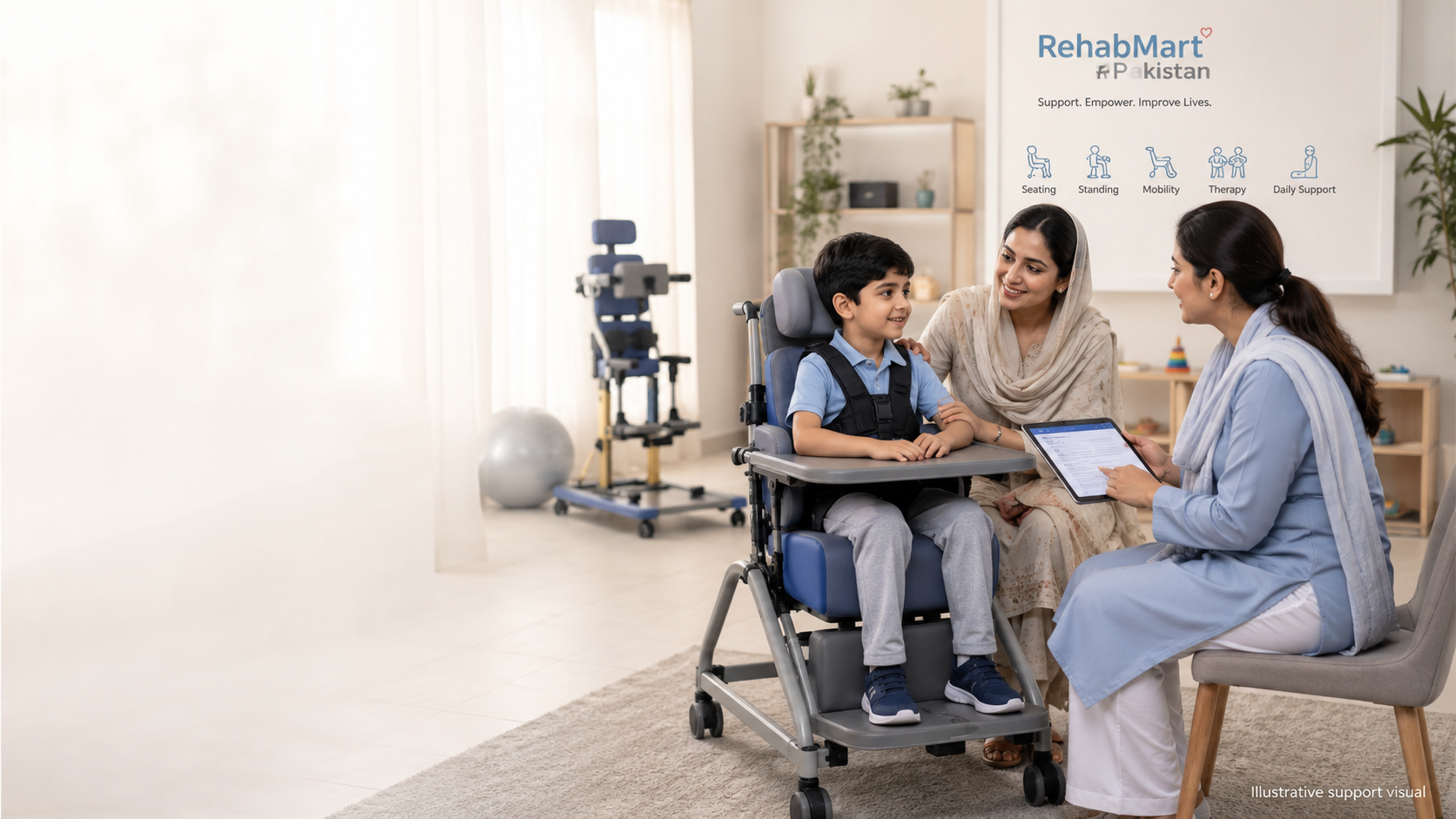
Every child with cerebral palsy is different. RehabMart Pakistan first understands the child's sitting, posture, standing, walking, daily-care, and caregiver-support needs before recommending equipment.
Har bacha different hota hai. CP chair har child ke liye same solution nahi hota. Pehle sitting, standing, walking aur daily care need samajhna zaroori hota hai.
Choose SafetyAid & Co. for CP, pediatric and complex assistive-technology cases in Pakistan or internationally. Choose RehabMart for Pakistan equipment shopping, quotations and general rehabilitation fulfilment.
RehabMart handles product shopping, quotations, made-to-order equipment, manufacturing, fitting, delivery and general rehabilitation enquiries across Pakistan.
SafetyAid & Co. supports CP, pediatric and complex assistive-technology cases in Pakistan and internationally.
Many parents ask for a CP chair first, but the right solution depends on the child's actual need. A child who falls sideways may need postural seating. A child who cannot tolerate standing may need standing support first. A child who wants to walk but loses balance may need a gait trainer, posture walker, or CP walker. Daily care also matters, including toileting, bathing, transfers, and caregiver safety.
Pehle bache ki need samjhein, phir product select karein.
The child may slide forward, bend, or need trunk and pelvic support.
Side support, postural seating, or corner sitting support may be needed after review.
Some children need safe standing, weight-bearing, and alignment support before walking.
A gait trainer, CP walker, posture walker, or walking support system may be considered.
Bathing, toileting, and hygiene routines may need safer support and caregiver planning.
Transfer support and safer handling may reduce daily-care risk for the family.
For sitting support, feeding posture, trunk support, pelvic positioning, and safer daily care.
For supported upright positioning, weight bearing, alignment, and standing practice.
For assisted stepping, balance support, posture control, and walking practice.
For children who need guided walking support, forearm support, or posture-aware mobility help.
For safer bathing, hygiene, commode use, bathroom positioning, and caregiver assistance.
For safer movement, repositioning, bed-to-chair support, caregiver handling, and home routines.
Children with cerebral palsy can have different GMFCS levels, posture needs, tone, balance, head control, trunk control, hip position, fatigue, and family routines. One child may need simple sitting support. Another may need pelvic support, head support, standing support, gait training, bathroom positioning, or transfer support. The right equipment depends on the child, not just the diagnosis.
CP chair, postural seating, corner chair, activity sitting, floor sitting, trunk support, pelvic support, tray support, and feeding posture support.
Standing frame, upright positioning, alignment, knee/foot positioning, weight bearing, trunk support, and supported standing practice.
Standing Frame for Children in PakistanGait trainer, posture walker, CP walker, balance support, stepping support, and caregiver-assisted walking practice.
Toilet safety, bath support, hygiene routines, daily positioning, and safer care planning may be part of the CP support pathway.
Moving the child safely, reducing lifting difficulty, and improving caregiver routine can be as important as the main equipment.
RehabMart may recommend sitting support, standing support, walking support, daily-care support, or a combination depending on assessment, safety, functional level, and family goals.
Photos, short videos, and basic measurements help SafetyAid & Co. review sitting posture, standing ability, walking support, current chair or walker use, and caregiver handling needs. Final guidance depends on specialist review, safety needs, and family goals.
SafetyAid & Co. reviews the child's basic details, photos or videos, posture, size, support level, and family routine before solution planning. RehabMart then manages the Pakistan quotation, order, fitting, delivery, and follow-up under the same case reference, retaining the SA or RM origin prefix.
Images and examples on this page are for guidance only. Final product selection, support level, size, and accessories depend on assessment.
Families from Rawalpindi, Islamabad, and other cities in Pakistan can start with WhatsApp or the assessment form. RehabMart reviews the child's sitting ability, posture, standing potential, walking support, current equipment, photos/videos if available, and caregiver goals before suggesting a suitable support pathway.
No. Some children need a CP chair, but others may need corner sitting support, standing support, gait training support, CP walker support, bathroom safety, transfer support, or a combination.
The right equipment depends on sitting control, posture, head control, standing ability, walking potential, safety, size, daily routine, and caregiver needs.
Children with cerebral palsy may need CP chairs, postural seating, standing frames, gait trainers, posture walkers, bathroom support, transfer support, daily-care aids, or custom assistive technology depending on assessment.
It depends on assessment. Some children need sitting support first, some need standing support, and some may be ready for walking or gait support.
A standing frame may be considered when a child needs supported upright positioning, weight-bearing practice, alignment support, or participation in a safe standing posture.
A gait trainer may be considered when a child has walking potential but needs support for balance, trunk control, stepping practice, pelvic position, endurance, or safety.
Yes. Families can send basic details, photos, and short videos on WhatsApp. RehabMart can guide the next step and advise whether assessment or appointment-based review is needed.
No. RehabMart does not guarantee results. Equipment is selected to support safety, positioning, daily care, and functional goals based on the child's needs.
Start with the child's sitting, standing, walking, daily-care, and safety needs. Send details on WhatsApp or start the assessment form, and RehabMart will guide the next step.